Friday, August 17, 2018

Indian Bank Hit in $13.5M Cyberheist After FBI ATM Cashout Warning

On Sunday, Aug. 12, KrebsOnSecurity carried an exclusive: The FBI was warning banks about an imminent “ATM cashout” scheme about to unfold across the globe, thanks to a data breach at an unknown financial institution. On Aug. 14, a bank in India disclosed hackers had broken into its servers, stealing nearly $2 million in fraudulent bank transfers and $11.5 million unauthorized ATM withdrawals from more than two dozen cash machines across multiple countries.

The FBI put out its alert on Friday, Aug. 10. The criminals who hacked into Pune, India-based Cosmos Bank executed their two-pronged heist the following day, sending co-conspirators to fan out and withdraw a total of about $11.5 million from 25 ATMs in Canada, Hong Kong and India.

The FBI warned it had intelligence indicating that criminals had breached an unknown payment provider’s network with malware to access bank customer card information and exploit network access, enabling large scale theft of funds from ATMs.

Organized cybercrime gangs that coordinate these so-called “unlimited attacks” typically do so by hacking or phishing their way into a bank or payment card processor. Just prior to executing on ATM cashouts, the intruders will remove many fraud controls at the financial institution, such as maximum withdrawal amounts and any limits on the number of customer ATM transactions daily.

The perpetrators alter account balances and security measures to make an unlimited amount of money available at the time of the transactions, allowing for large amounts of cash to be quickly removed from the ATM.

My story about the FBI alert was breaking news on Sunday, but it was just a day short of useful to financial institutions impacted by the breach and associated ATM cashout blitz.

But according to Indian news outlet Dailypionneer.com, there was a second attack carried out on August 13, when the Cosmos Bank hackers transferred nearly $2 million to the account of ALM Trading Limited at Hang Seng Bank in Hong Kong.

“The bank came to know about the malware attack on its debit card payment system on August 11, when it was observed that unusually repeated transactions were taking place through ATM VISA and Rupay Card for nearly two hours,” writes TN Raghunatha for the Daily Pioneer.

Cosmos Bank was quick to point out that the attackers did not access systems tied to customer accounts, and that the money taken was from the bank’s operating accounts. The 112-year-old bank blamed the attack on “a switch which is operative for the payment gateway of VISA/Rupay Debit card and not on the core banking system of the bank, the customers’ accounts and the balances are not at all affected.”

Visa issued a statement saying it was aware of the compromise affecting a client financial institution in India.

“Our systems were able to identify the issue quickly, enabling the financial institution to take appropriate action,” the company said. “Visa is working closely with the client in supporting their ongoing investigations on the matter.”

The FBI said these types of ATM cashouts are most common at smaller financial institutions that may not have sufficient resources dedicated to staying up to date with the latest security measures for handling payment card data.

“Historic compromises have included small-to-medium size financial institutions, likely due to less robust implementation of cyber security controls, budgets, or third-party vendor vulnerabilities,” the alert read. “The FBI expects the ubiquity of this activity to continue or possibly increase in the near future.”

In July 2018, KrebsOnSecurity broke the news of two separate cyber break-ins at tiny National Bank of Blacksburg in Virginia in a span of just eight months that led to ATM cashouts netting thieves more than $2.4 million. The Blacksburg bank is now suing its insurance provider for refusing to fully cover the loss.

As reported by Reuters, Cosmos Bank said in a press statement that its main banking software receives debit card payment requests via a “switching system” that was bypassed in the attack. “During the malware attack, a proxy switch was created and all the fraudulent payment approvals were passed by the proxy switching system,” the bank said.

Translation: If a financial institution is not fully encrypting its payment processing network, this can allow intruders with access to the network to divert and/or alter the response that gets sent when an ATM transaction is requested. In one such scenario, the network might say a given transaction should be declined, but thieves could still switch the signal for that ATM transaction from “declined” to “approved.”

One final note: Several news outlets have confused the attack that hit Cosmos Bank with another ATM crime called “jackpotting,” which requires thieves to have physical access to the inside of the cash machine and the ability to install malicious software that makes the ATM spit out large chunks of cash at once. Like ATM cashouts/unlimited operations, jackpotting attacks do not directly affect customer accounts but instead drain ATMs of currency.


from
https://krebsonsecurity.com/2018/08/indian-bank-hit-in-13-5m-cyberheist-after-fbi-atm-cashout-warning/

Thursday, August 16, 2018

Hanging Up on Mobile in the Name of Security

An entrepreneur and virtual currency investor is suing AT&T for $224 million, claiming the wireless provider was negligent when it failed to prevent thieves from hijacking his mobile account and stealing millions of dollars in cryptocurrencies. Increasingly frequent, high-profile attacks like these are prompting some experts to say the surest way to safeguard one’s online accounts may be to disconnect them from the mobile providers entirely.
The claims come in a lawsuit filed this week in Los Angeles on behalf of Michael Terpin, who co-founded the first angel investor group for bitcoin enthusiasts in 2013. Terpin alleges that crooks stole almost $24 million worth of cryptocurrency after fraudulently executing a “SIM swap” on his mobile phone account at AT&T in early 2018.

A SIM card is the tiny, removable chip in a mobile device that allows it to connect to the provider’s network. Customers can legitimately request a SIM swap when their existing SIM card has been damaged, or when they are switching to a different phone that requires a SIM card of another size.

But SIM swaps are frequently abused by scam artists who trick mobile providers into tying a target’s service to a new SIM card and mobile phone that the attackers control. Unauthorized SIM swaps often are perpetrated by fraudsters who have already stolen or phished a target’s password, as many banks and online services rely on text messages to send users a one-time code that needs to be entered in addition to a password for online authentication.

Terpin alleges that on January 7, 2018, someone requested an unauthorized SIM swap on his AT&T account, causing his phone to go dead and sending all incoming texts and phone calls to a device the attackers controlled. Armed with that access, the intruders were able to reset credentials tied to his cryptocurrency accounts and siphon nearly $24 million worth of digital currencies.

According to Terpin, this was the second time in six months someone had hacked his AT&T number. On June 11, 2017, Terpin’s phone went dead. He soon learned his AT&T password had been changed remotely after 11 attempts in AT&T stores had failed. At the time, AT&T suggested Terpin take advantage of the company’s “extra security” feature — a customer-specified six-digit PIN which is required before any account changes can be made.

Terpin claims an investigation by AT&T into the 2018 breach found that an employee at an AT&T store in Norwich, Conn. somehow executed the SIM swap on his account without having to enter his “extra security” PIN, and that AT&T knew or should have known that employees could bypass its customer security measures.

Terpin is suing AT&T for his $24 million worth of cryptocurrencies, plus $200 million in punitive damages. A copy of his complaint is here (PDF).

AT&T declined to comment on specific claims in the lawsuit, saying only in a statement that, “We dispute these allegations and look forward to presenting our case in court.”

AN ‘IDENTITY CRISIS’?

Mobile phone companies are a major weak point in authentication because so many companies have now built their entire procedure for authenticating customers on a process that involves sending a one-time code to the customer via SMS or automated phone call.

In some cases, thieves executing SIM swaps have already phished or otherwise stolen a target’s bank or email password. But many major social media platforms — such as Instagramallow users to reset their passwords using nothing more than text-based (SMS) authentication, meaning thieves can hijack those accounts just by having control over the target’s mobile phone number.

Allison Nixon is director of security research at Flashpoint, a security company in New York City that has been closely tracking the murky underworld of communities that teach people how to hijack phone numbers assigned to customer accounts at all of the major mobile providers.

Nixon calls the current SIM-jacking craze “a major identity crisis” for cybersecurity on multiple levels.

“Phone numbers were never originally intended as an identity document, they were designed as a way to contact people,” Nixon said. “But because of all these other companies are building in security measures, a phone number has become an identity document.”

In essence, mobile phone companies have become “critical infrastructure” for security precisely because so much is riding on who controls a given mobile number. At the same time, so little is needed to undo weak security controls put in place to prevent abuse.

“The infrastructure wasn’t designed to withstand the kind of attacks happening now,” Nixon said. “The protocols need to be changed, and there are probably laws affecting the telecom companies that need to be reviewed in light of how these companies have evolved.”

Unfortunately, with the major mobile providers so closely tied to your security, there is no way you can remove the most vulnerable chunks of this infrastructure — the mobile store employees who can be paid or otherwise bamboozled into helping these attacks succeed.

No way, that is, unless you completely disconnect your mobile phone number from any sort of SMS-based authentication you currently use, and replace it with Internet-based telephone services that do not offer “helpful” customer support — such as Google Voice.

Google Voice lets users choose a phone number that gets tied to their Google account, and any calls or messages to that number will be forwarded to your mobile number. But unlike phone numbers issued by the major mobile providers, Google Voice numbers can’t be stolen unless someone also hacks your Google password — in which case you likely have much bigger problems.

With Google Voice, there is no customer service person who can be conned over the phone into helping out. There is no retail-store employee who will sell access to your SIM information for a paltry $80 payday. In this view of security, customer service becomes a customer disservice.

Mind you, this isn’t my advice. The above statement summarizes the arguments allegedly made by one of the most accomplished SIM swap thieves in the game today. On July 12, 2018, police in California arrested Joel Ortiz, a 20-year-old college student from Boston who’s accused of using SIM swaps to steal more than $5 million in cryptocurrencies from 40 victims.

Ortiz allegedly had help from a number of unnamed accomplices who collectively targeted high-profile and wealthy people in the cryptocurrency space. In one of three brazen attacks at a bitcoin conference this year, Ortiz allegedly used his SIM swapping skills to steal more than $1.5 million from a cryptocurrency entrepreneur, including nearly $1 million the victim had crowdfunded.
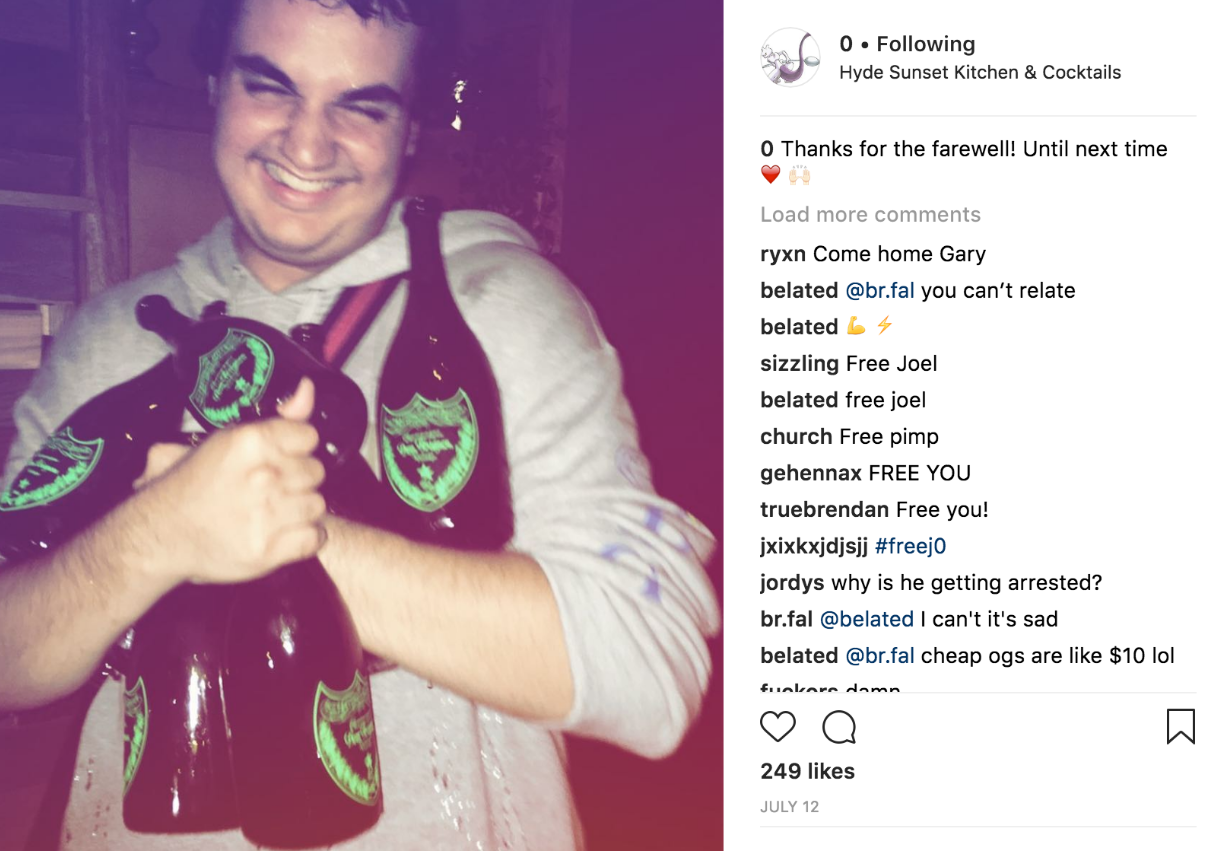
A July 2018 posting from the “OG” Instagram account “0”, allegedly an account hijacked by Joel Ortiz (pictured holding an armload of Dom Perignon champagne).

Ortiz reportedly was a core member of OGUsers[dot]com, a forum that’s grown wildly popular among criminals engaging in SIM swaps to steal cryptocurrency and hijack high-value social media accounts. OG is short for “original gangster,” and it refers to a type of “street cred” for possession of social media account names that are relatively short (between one and six characters). On ogusers[dot]com, Ortiz allegedly picked the username “j”. Short usernames are considered more valuable because they confer on the account holder the appearance of an early adopter on most social networks.

Discussions on the Ogusers forum indicate Ortiz allegedly is the current occupant of perhaps the most OG username on Twitter — an account represented by the number zero “0”. The alias displayed on that twitter profile is “j0”. He also apparently controls the Instagram account by the same number, as well as the Instagram account “t”, which lists its alias as “Joel.”

Shown below is a cached snippet from an Ogusers forum posting by “j” (allegedly Ortiz), advising people to remove their mobile phone number from all important multi-factor authentication options, and to replace it with something like Google Voice.
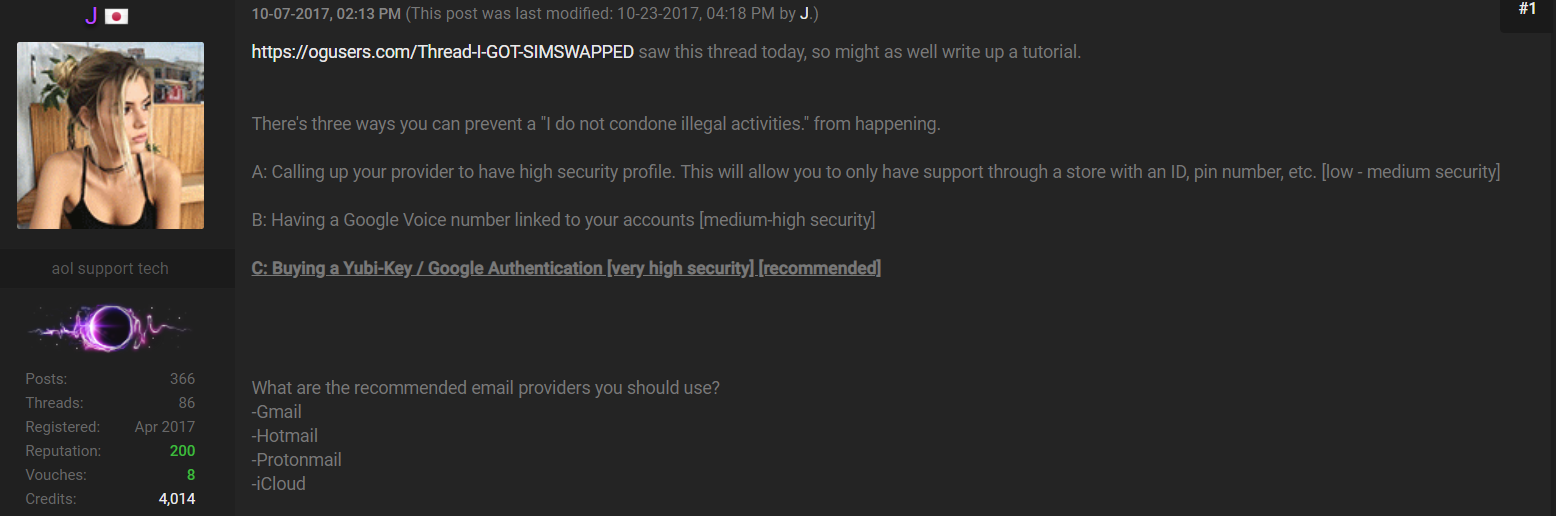
Ogusers SIM swapper “j” advises forum members on how not to become victims of SIM swapping. Click to enlarge.

WHAT CAN YOU DO?

All four major wireless carriers — AT&T, Sprint, T-Mobile and Verizon — let customers add security against SIM swaps and related schemes by setting a PIN that needs to be provided over the phone or in person at a store before account changes should be made. But these security features can be bypassed by incompetent or corrupt mobile store employees.

Mobile store employees who can be bought or tricked into conducting SIM swaps are known as “plugs” in the Ogusers community, and without them SIM swapping schemes become much more difficult.

Last week, KrebsOnSecurity broke the news that police in Florida had arrested a 25-year-old man who’s accused of being part of a group of at least nine individuals who routinely conducted fraudulent SIM swaps on high-value targets. Investigators in that case say they have surveillance logs that show the group discussed working directly with mobile store employees to complete the phone number heists.

In May I wrote about a 27-year-old Boston man who had his three-letter Instagram account name stolen after thieves hijacked his number at T-Mobile. Much like Mr. Terpin, the victim in that case had already taken T-Mobile’s advice and placed a PIN on his account that was supposed to prevent the transfer of his mobile number. T-Mobile ultimately acknowledged that the heist had been carried out by a rogue T-Mobile store employee.

So consider establishing a Google Voice account if you don’t already have one. In setting up a new number, Google requires you to provide a number capable of receiving text messages. Once your Google Voice number is linked to your mobile, the device at the mobile number you gave to Google should notify you instantly if anyone calls or messages the Google number (this assumes your phone has a Wi-Fi or mobile connection to the Internet).

After you’ve done that, take stock of every major account you can think of, replacing your mobile phone number with your Google Voice number in every case it is listed in your profile.

Here’s where it gets tricky. If you’re all-in for taking the anti-SIM-hacking advice allegedly offered by Mr. Ortiz, once you’ve changed all of your multi-factor authentication options from your mobile number to your Google Voice number, you then have to remove that mobile number you supplied to Google from your Google Voice account. After that, you can still manage calls/messages to and from your Google Voice number using the Google Voice mobile app.

And notice what else Ortiz advises in the screen shot above to secure one’s Gmail and other Google accounts: Using a physical security key (where possible) to replace passwords. This post from a few weeks back explains what security keys are, how they can help harden your security posture, and how to use them. If Google’s own internal security processes count for anything, the company recently told this author that none of its 85,000 employees had been successfully phished for their work credentials since January 2017, when Google began requiring all employees to use physical security keys in place of one-time passwords sent to a mobile device.

Standard disclaimer: If the only two-factor authentication offered by a company you use is based on sending a one-time code via SMS or automated phone call, this is still better than relying on simply a password alone. But one-time codes generated by a mobile phone app such as Authy or Google Authenticator are more secure than SMS-based options because they are not directly vulnerable to SIM-swapping attacks.

The web site twofactorauth.org breaks down online service providers by the types of secondary authentication offered (SMS, call, app-based one-time codes, security keys). Take a moment soon to review this important resource and harden your security posture wherever possible.


from
https://krebsonsecurity.com/2018/08/hanging-up-on-mobile-in-the-name-of-security/

Wednesday, August 15, 2018

Patch Tuesday, August 2018 Edition

Adobe and Microsoft each released security updates for their software on Tuesday. Adobe plugged five security holes in its Flash Player browser plugin. Microsoft pushed 17 updates to fix at least 60 vulnerabilities in Windows and other software, including two “zero-day” flaws that attackers were already exploiting before Microsoft issued patches to fix them.

According to security firm Ivanti, the first of the two zero-day flaws (CVE-2018-8373) is a critical flaw in Internet Explorer that attackers could use to foist malware on IE users who browse to hacked or booby-trapped sites. The other zero-day is a bug (CVE-2018-8414) in the Windows 10 shell that could allow an attacker to run code of his choice.

Microsoft also patched more variants of the Meltdown/Spectre memory vulnerabilities, collectively dubbed “Foreshadow” by a team of researchers who discovered and reported the Intel-based flaws. For more information about how Foreshadow works, check out their academic paper (PDF), and/or the video below. Microsoft’s analysis is here.

One nifty little bug fixed in this patch batch is CVE-2018-8345. It addresses a problem in the way Windows handles shortcut files; ending in the “.lnk” extension, shortcut files are Windows components that link (hence the “lnk” extension) easy-to-recognize icons to specific executable programs, and are typically placed on the user’s Desktop or Start Menu.

That description of a shortcut file was taken verbatim from the first widely read report on what would later be dubbed the Stuxnet worm, which also employed an exploit for a weakness in the way Windows handled shortcut (.lnk) files. According to security firm Qualys, this patch should be prioritized for both workstations and servers, as the user does not need to click the file to exploit. “Simply viewing a malicious LNK file can execute code as the logged-in user,” Qualys’ Jimmy Graham wrote.

Not infrequently, Redmond ships updates that end up causing stability issues for some users, and it doesn’t hurt to wait a day or two before seeing if any major problems are reported with new updates before installing them. Microsoft doesn’t make it easy for Windows 10 users to change this setting, but it is possible. For all other Windows OS users, if you’d rather be alerted to new updates when they’re available so you can choose when to install them, there’s a setting for that in Windows Update.

It’s a good idea to get in the habit of backing up your computer before applying monthly updates from Microsoft. Windows has some built-in tools that can help recover from bad patches, but restoring the system to a backup image taken just before installing updates is often much less hassle and an added piece of mind while you’re sitting there praying for the machine to reboot successfully after patching.

Adobe’s Flash update brings the program to v. 30.0.0.154 for Windows, macOS, Chrome and Linux. Most readers here know how I feel about Flash, which is a major security liability and a frequent target of browser-based attacks. The updates from Microsoft include these Flash fixes for IE, and Google Chrome has already pushed an update to address these five Flash flaws (although a browser restart may be needed).
But seriously, if you don’t have a specific need for Flash, just disable it already. Chrome is set to ask before playing Flash objects, but disabling Flash in Chrome is simple enough. Paste “chrome://settings/content” into a Chrome browser bar and then select “Flash” from the list of items. By default it should be set to “Ask first” before running Flash, although users also can disable Flash entirely here or whitelist and blacklist specific sites.

By default, Mozilla Firefox on Windows computers with Flash installed runs Flash in a “protected mode,” which prompts the user to decide if they want to enable the plugin before Flash content runs on a Web site.

Adobe also released security updates for its PDF Reader and Acrobat products.

As always, please leave a note in the comments below if you experience any problems installing any of these updates.


from
https://krebsonsecurity.com/2018/08/patch-tuesday-august-2018-edition/

Sunday, August 12, 2018

FBI Warns of ‘Unlimited’ ATM Cashout Blitz

The Federal Bureau of Investigation (FBI) is warning banks that cybercriminals are preparing to carry out a highly choreographed, global fraud scheme known as an “ATM cash-out,” in which crooks hack a bank or payment card processor and use cloned cards at cash machines around the world to fraudulently withdraw millions of dollars in just a few hours.

“The FBI has obtained unspecified reporting indicating cyber criminals are planning to conduct a global Automated Teller Machine (ATM) cash-out scheme in the coming days, likely associated with an unknown card issuer breach and commonly referred to as an ‘unlimited operation’,” reads a confidential alert the FBI shared with banks privately on Friday.


The FBI said unlimited operations compromise a financial institution or payment card processor with malware to access bank customer card information and exploit network access, enabling large scale theft of funds from ATMs.

“Historic compromises have included small-to-medium size financial institutions, likely due to less robust implementation of cyber security controls, budgets, or third-party vendor vulnerabilities,” the alert continues. “The FBI expects the ubiquity of this activity to continue or possibly increase in the near future.”

Organized cybercrime gangs that coordinate unlimited attacks typically do so by hacking or phishing their way into a bank or payment card processor. Just prior to executing on ATM cashouts, the intruders will remove many fraud controls at the financial institution, such as maximum ATM withdrawal amounts and any limits on the number of customer ATM transactions daily.

The perpetrators also alter account balances and security measures to make an unlimited amount of money available at the time of the transactions, allowing for large amounts of cash to be quickly removed from the ATM.

“The cyber criminals typically create fraudulent copies of legitimate cards by sending stolen card data to co-conspirators who imprint the data on reusable magnetic strip cards, such as gift cards purchased at retail stores,” the FBI warned. “At a pre-determined time, the co-conspirators withdraw account funds from ATMs using these cards.”

Virtually all ATM cashout operations are launched on weekends, often just after financial institutions begin closing for business on Saturday. Last month, KrebsOnSecurity broke a story about an apparent unlimited operation used to extract a total of $2.4 million from accounts at the National Bank of Blacksburg in two separate ATM cashouts between May 2016 and January 2017.

In both cases, the attackers managed to phish someone working at the Blacksburg, Virginia-based small bank. From there, the intruders compromised systems the bank used to manage credits and debits to customer accounts.

The 2016 unlimited operation against National Bank began Saturday, May 28, 2016 and continued through the following Monday. That particular Monday was Memorial Day, a federal holiday in the United States, meaning bank branches were closed for more than two days after the heist began. All told, the attackers managed to siphon almost $570,000 in the 2016 attack.

The Blacksburg bank hackers struck again on Saturday, January 7, and by Monday Jan 9 had succeeded in withdrawing almost $2 million in another unlimited ATM cashout operation.

The FBI is urging banks to review how they’re handling security, such as implementing strong password requirements and two-factor authentication using a physical or digital token when possible for local administrators and business critical roles.

Other tips in the FBI advisory suggested that banks:

-Implement separation of duties or dual authentication procedures for account balance or withdrawal increases above a specified threshold.

-Implement application whitelisting to block the execution of malware.

-Monitor, audit and limit administrator and business critical accounts with the authority to modify the account attributes mentioned above.

-Monitor for the presence of remote network protocols and administrative tools used to pivot back into the network and conduct post-exploitation of a network, such as Powershell, cobalt strike and TeamViewer.

-Monitor for encrypted traffic (SSL or TLS) traveling over non-standard ports.

-Monitor for network traffic to regions wherein you would not expect to see outbound connections from the financial institution.


from
https://krebsonsecurity.com/2018/08/fbi-warns-of-unlimited-atm-cashout-blitz/

Tuesday, August 7, 2018

Florida Man Arrested in SIM Swap Conspiracy

Police in Florida have arrested a 25-year-old man accused of being part of a multi-state cyber fraud ring that hijacked mobile phone numbers in online attacks that siphoned hundreds of thousands of dollars worth of bitcoin and other cryptocurrencies from victims.

On July 18, 2018, Pasco County authorities arrested Ricky Joseph Handschumacher, an employee of the city of Port Richey, Fla, charging him with grand theft and money laundering. Investigators allege Handschumacher was part of a group of at least nine individuals scattered across multiple states who for the past two years have drained bank accounts via an increasingly common scheme involving mobile phone “SIM swaps.”

A SIM card is the tiny, removable chip in a mobile device that allows it to connect to the provider’s network. Customers can legitimately request a SIM swap when their existing SIM card has been damaged, or when they are switching to a different phone that requires a SIM card of another size.

But SIM swaps are frequently abused by scam artists who trick mobile providers into tying a target’s service to a new SIM card and mobile phone that the attackers control. Unauthorized SIM swaps often are perpetrated by fraudsters who have already stolen or phished a target’s password, as many banks and online services rely on text messages to send users a one-time code that needs to be entered in addition to a password for online authentication.

In some cases, fraudulent SIM swaps succeed thanks to lax authentication procedures at mobile phone stores. In other instances, mobile store employees work directly with cyber criminals to help conduct unauthorized SIM swaps, as appears to be the case with the crime gang that allegedly included Handschumacher.

A WORRIED MOM

According to court documents, investigators first learned of the group’s activities in February 2018, when a Michigan woman called police after she overheard her son talking on the phone and pretending to be an AT&T employee. Officers responding to the report searched the residence and found multiple cell phones and SIM cards, as well as files on the kid’s computer that included “an extensive list of names and phone numbers of people from around the world.”

The following month, Michigan authorities found the same individual accessing personal consumer data via public Wi-Fi at a local library, and seized 45 SIM cards, a laptop and a Trezor wallet — a hardware device designed to store crytpocurrency account data. In April 2018, the mom again called the cops on her son — identified only as confidential source #1 (“CS1”) in the criminal complaint — saying he’d obtained yet another mobile phone.

Once again, law enforcement officers were invited to search the kid’s residence, and this time found two bags of SIM cards and numerous driver’s licenses and passports. Investigators said they used those phony documents to locate and contact several victims; two of the victims each reported losing approximately $150,000 in cryptocurrencies after their phones were cloned; the third told investigators her account was drained of $50,000.

CS1 later told investigators he routinely conducted the phone cloning and cashouts in conjunction with eight other individuals, including Handschumacher, who allegedly used the handle “coinmission” in the group’s daily chats via Discord and Telegram. Search warrants revealed that in mid-May 2018 the group worked in tandem to steal 57 bitcoins from one victim — then valued at almost $470,000 — and agreed to divide the spoils among members.

GRAND PLANS

Investigators soon obtained search warrants to monitor the group’s Discord server chat conversations, and observed Handschumacher allegedly bragging in these chats about using the proceeds of his alleged crimes to purchase land, a house, a vehicle and a “quad vehicle.” Interestingly, Handschumacher’s public Facebook page remains public, and is replete with pictures that he posted of recent new vehicle aquisitions, including a pickup truck and multiple all-terrain vehicles and jet skis.

The Pasco County Sherrif’s office says their surveillance of the Discord server revealed that the group routinely paid employees at cellular phone companies to assist in their attacks, and that they even discussed a plan to hack accounts belonging to the CEO of cryptocurrency exchange Gemini Trust Company. The complaint doesn’t mention the CEO by name, but the current CEO is bitcoin billionaire Tyler Winklevoss, who co-founded the exchange along with his twin brother Cameron.

“Handschumacher and another co-conspirator talk about compromising the CEO of Gemini and posted his name, date of birth, Skype username and email address into the conversation,” the complaint reads. “Handschumacher and the co-conspirators discuss compromising the CEO’s Skype account and T-Mobile account. The co-conspirator states he will call his ‘guy’ at T-Mobile to ask about the CEO’s account.”

Court documents state that the group used Coinbase.com and multiple other cryptocurrency exchanges to launder the proceeds of their thefts in a bid to obfuscate the source of the stolen funds. Subpoenas to Coinbase revealed Handschumacher had a total of 82 bitcoins sold from or sent to his account, and that virtually all of the funds were received via outside sources (as opposed to being purchased through Coinbase).

Neither Handschumacher nor his attorney responded to requests for comment. The complaint against Handschumacher says that following his arrest he confessed to his involvement in the group, and that he admitted to using his cell phone to launder cryptocurrency in amounts greater than $100,000.

But on July 23, Handschumacher’s attorney entered a plea of “not guilty” on behalf of his client, who is now facing charges of grand larceny, money laundering, and accessing a computer or electronic device without authorization.

Handschumacher’s arrest comes on the heels of an apparent law enforcement crackdown on individuals involved in SIM swap schemes. As first reported by Motherboard.com earlier this month, on July 12, police in California arrested Joel Ortiz — a 20-year-old college student accused of being part of a group of criminals who hacked dozens of cellphone numbers to steal more than $5 million in cryptocurrency.

The Motherboard story notes that Ortiz allegedly was an active member of OGusers[dot]com, a marketplace for Twitter and Instagram usernames that SIM swapping hackers use to sell stolen accounts — usually one- to six-letter usernames. Short usernames are something of a prestige or status symbol for many youngsters, and some are willing to pay surprising sums of money for them.

Sources familiar with the investigation tell KrebsOnSecurity that Handschumacher also was a member of OGUsers, although it remains unclear how active he may have been there.

WHAT YOU CAN DO

All four major U.S. mobile phone companies allow customers to set personal identification numbers (PINs) on their accounts to help combat SIM swaps, as well as another type of phone hijacking known as a number port-out scam. But these precautions may serve as little protection against crooked insiders working at mobile phone retail locations. On May 18, KrebsOnSecurity published a story about a Boston man who had his three-letter Instagram username hijacked after attackers executed a SIM swap against his T-Mobile account. According to T-Mobile, that attack was carried out with the help of a rogue company employee.

SIM swap scams illustrate a crucial weak point of multi-factor authentication methods that rely on a one-time code sent either via text message or an automated phone call. If an online account that you value offers more robust forms of multi-factor authentication — such as one-time codes generated by an app, or better yet hardware-based security keys — please consider taking full advantage of those options.

If, however, SMS-based authentication is the only option available, this is still far better than simply relying on a username and password to protect the account. If you haven’t done so lately, head on over to twofactorauth.org, which maintains probably the most comprehensive list of which sites support multi-factor authentication, indexing each by type of site (email, gaming, finance, etc) and the type of added authentication offered (SMS, phone call, software/hardware token, etc.).


from
https://krebsonsecurity.com/2018/08/florida-man-arrested-in-sim-swap-conspiracy/

Friday, August 3, 2018

Credit Card Issuer TCM Bank Leaked Applicant Data for 16 Months

TCM Bank, a company that helps more than 750 small and community U.S. banks issue credit cards to their account holders, said a Web site misconfiguration exposed the names, addresses, dates of birth and Social Security numbers of thousands of people who applied for cards between early March 2017 and mid-July 2018.

TCM is a subsidiary of Washington, D.C.-based ICBA Bancard Inc., which helps community banks provide a credit card option to their customers using bank-branded cards.

In a letter being mailed to affected customers today, TCM said the information exposed was data that card applicants uploaded to a Web site managed by a third party vendor. TCM said it learned of the issue on July 16, 2018, and had the problem fixed by the following day.

Bruce Radke, an attorney working with ICBA on its breach outreach efforts to customers, said fewer than 10,000 consumers who applied for cards were affected. Radke declined to name the third-party vendor, saying TCM was contractually prohibited from doing so.

“It was less than 25 percent of the applications we processed during the relevant time period that were potentially affected, and less than one percent of our cardholder base was affected here,” Radke said. “We’ve since confirmed the issue has been corrected, and we’re requiring the vendor to look at their technologies and procedures to detect and prevent similar issues going forward.”

ICBA Bancard is the payments subsidiary of the Independent Community Bankers of America, a organization representing more than 5,700 financial institutions that has been fairly vocal about holding retailers accountable for credit card breaches over the years. Last year, the ICBA sued Equifax over the big-three credit bureau’s massive data breach that exposed the Social Security numbers and other sensitive data on nearly 150 million Americans.

Many companies that experience a data breach or data leak are quick to place blame for the incident on a third-party that mishandled sensitive information. Sometimes this blame is entirely warranted, but more often such claims ring hollow in the ears of those affected — particularly when they come from banks and security providers. For example, identity theft protection provider LifeLock recently addressed a Web site misconfiguration that exposed the email addresses of millions of customers. LifeLock’s owner Symantec later said it fixed the flaw, which it blamed on a mistake by an unnamed third-party marketing partner.

Managing third-party risk can be challenging, especially for organizations with hundreds or thousands of partners (consider the Target breach, which began with an opportunistic malware compromise at a heating and air conditioning vendor). Nevertheless, organizations of all shapes and sizes need to be vigilant about making sure their partners are doing their part on security, lest third-party risk devolves into a first-party breach of customer trust.


from
https://krebsonsecurity.com/2018/08/credit-card-issuer-tcm-bank-leaked-applicant-data-for-16-months/

Thursday, August 2, 2018

The Year Targeted Phishing Went Mainstream

A story published here on July 12 about a new sextortion-based phishing scheme that invokes a real password used by each recipient has become the most-read piece on KrebsOnSecurity since this site launched in 2009. And with good reason — sex sells (the second most-read piece here was my 2015 scoop about the Ashley Madison hack).

But beneath the lurid allure of both stories lies a more unsettling reality: It has never been easier for scam artists to launch convincing, targeted phishing and extortion scams that are automated on a global scale. And given the sheer volume of hacked and stolen personal data now available online, it seems almost certain we will soon witness many variations on these phishing campaigns that leverage customized data elements to enhance their effectiveness.

The sextortion scheme that emerged this month falsely claims to have been sent from a hacker who’s compromised your computer and used your webcam to record a video of you while you were watching porn. The missive threatens to release the video to all your contacts unless you pay a Bitcoin ransom.

What spooked people most about this scam was that its salutation included a password that each recipient legitimately used at some point online. Like most phishing attacks, the sextortion scheme that went viral this month requires just a handful of recipients to fall victim for the entire scheme to be profitable.

From reviewing the Bitcoin addresses readers shared in the comments on that July 12 sextortion story, it is clear this scam tricked dozens of people into paying anywhere from a few hundred to thousands of dollars in Bitcoin. All told, those addresses received close to $100,000 in payments over the past two weeks.

And that is just from examining the Bitcoin addresses posted here; the total financial haul from different versions of this attack is likely far higher. A more comprehensive review by the Twitter user @SecGuru_OTX and posted to Pastebin suggests that as of July 26 there were more than 300 Bitcoin addresses used to con at least 150 victims out of a total of 30 Bitcoins, or approximately $250,000.

There are several interesting takeaways from this phishing campaign. The first is that it effectively inverted a familiar threat model: Most phishing campaigns try to steal your password, whereas this one leads with it.

A key component of a targeted phishing attack is personalization. And purloined passwords are an evergreen lure because your average Internet user hasn’t the slightest inkling of just how many of their passwords have been breached, leaked, lost or stolen over the years.

This was evidenced by the number of commenters here who acknowledged that the password included in the extortion email was one they were still using, with some even admitting they were using the password at multiple sites! 

Surprisingly, none of the sextortion emails appeared to include a Web site link of any kind. But consider how effective this “I’ve got your password” scam would be at enticing a fair number of recipients into clicking on one.

In such a scenario, the attacker might configure the link to lead to an “exploit kit,” crimeware designed to be stitched into hacked or malicious sites that exploits a variety of Web-browser vulnerabilities for the purposes of installing malware of the attacker’s choosing.

Also, most of the passwords referenced in the sextortion campaign appear to have been slurped from data breaches that are now several years old. For example, many readers reported that the password they received was the one compromised in LinkedIn’s massive 2012 data breach.

Now imagine how much more convincing such a campaign would be if it leveraged a fresh password breach — perhaps one that the breached company wasn’t even aware of yet.

There are many other data elements that could be embedded in extortion emails to make them more believable, particularly with regard to freshly-hacked databases. For example, it is common for user password databases that are stolen from hacked companies to include the Internet Protocol (IP) addresses used by each user upon registering their account.

This could be useful for phishers because there are many automated “geo-IP” services that try to determine the geographical location of Website visitors based on their Internet addresses.

Some of these services allow users to upload large lists of IP addresses and generate links that plot each address on Google Maps. Suddenly, the phishing email not only includes a password you are currently using, but it also bundles a Google Street View map of your neighborhood!

There are countless other ways these schemes could become far more personalized and terrifying — all in an automated fashion. The point is that automated, semi-targeted phishing campaigns are likely here to stay.

Here are some tips to help avoid falling prey to these increasingly sophisticated phishing schemes:

Avoid clicking on links and attachments in email, even in messages that appear to be sent from someone you know.

Urgency should be a giant red flag. Most phishing scams invoke a temporal element that warns of dire consequences should you fail to respond or act quickly. Take a deep breath. If you’re unsure whether the message is legitimate, visit the site or service in question manually (ideally, using a browser bookmark so as to avoid potential typosquatting sites).

Don’t re-use passwords. If you’re the kind of person who likes to use the same password across multiple sites, then you definitely need to be using a password manager. That’s because password managers handle the tedious task of creating and remembering unique, complex passwords on your behalf; all you need to do is remember a single, strong master password or passphrase. In essence, you effectively get to use the same password across all Web sites.

Some of the more popular password managers include DashlaneKeepass, LastPass. [Side note: Using unique passwords at each site also can provide a strong clue about which Web site likely got breached in the event that said password shows up in one of these targeted phishing attacks going forward].

-Do not respond to spam or phishing emails. Several readers reported sending virtual nastygrams back to their would-be sextortionists. Please resist any temptation to reply. In all likelihood, the only thing a reply will accomplish is letting the attackers know they have a live one on the hook, and ensuring that your email address will receive even more scams and spams in the future.

-Don’t pay off extortionists. For the same reason that replying to spammers is a bad idea, rewarding extortionists only serves to further the victimization of yourself and others. Also, even if someone really does have the goods on you, there is no way that you as the victim can be sure that paying makes the threat go away.


from
https://krebsonsecurity.com/2018/08/the-year-targeted-phishing-went-mainstream/