Wednesday, August 1, 2018

Reddit Breach Highlights Limits of SMS-Based Authentication

Reddit.com today disclosed that a data breach exposed some internal data, as well as email addresses and passwords for some Reddit users. As Web site breaches go, this one doesn’t seem too severe. What’s interesting about the incident is that it showcases once again why relying on mobile text messages (SMS) for two-factor authentication (2FA) can lull companies and end users into a false sense of security.

In a post to Reddit, the social news aggregation platform said it learned on June 19 that between June 14 and 18 an attacker compromised a several employee accounts at its cloud and source code hosting providers.

Reddit said the exposed data included internal source code as well as email addresses and obfuscated passwords for all Reddit users who registered accounts on the site prior to May 2007. The incident also exposed the email addresses of some users who had signed up to receive daily email digests of specific discussion threads.
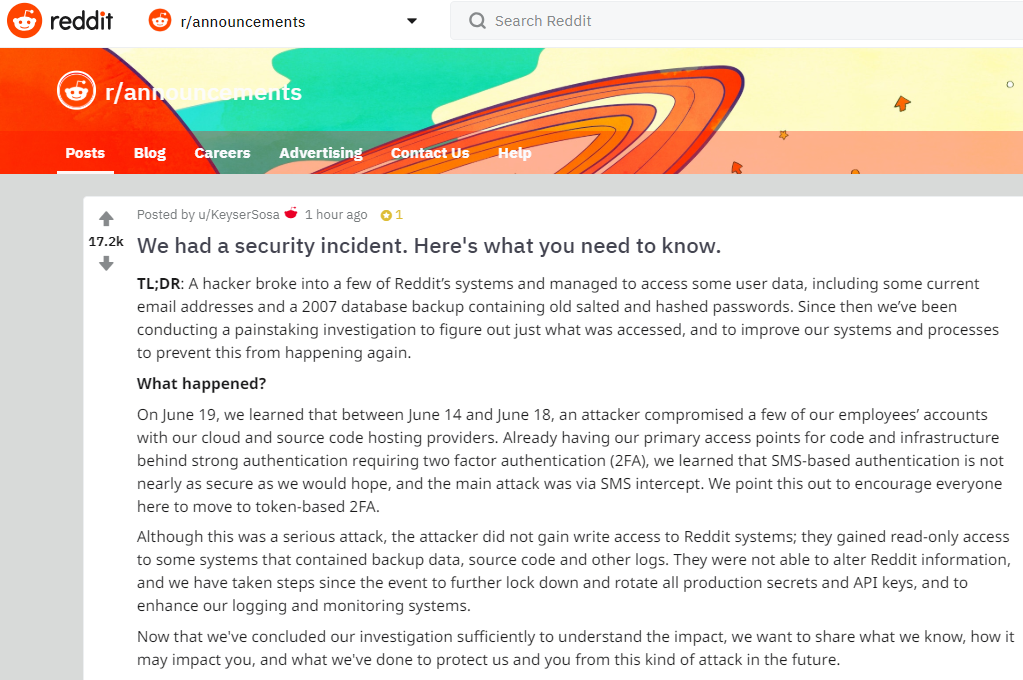
Of particular note is that although the Reddit employee accounts tied to the breach were protected by SMS-based two-factor authentication, the intruder(s) managed to intercept that second factor.

“Already having our primary access points for code and infrastructure behind strong authentication requiring two factor authentication (2FA), we learned that SMS-based authentication is not nearly as secure as we would hope, and the main attack was via SMS intercept,” Reddit disclosed. “We point this out to encourage everyone here to move to token-based 2FA.”

Reddit didn’t specify how the SMS code was stolen, although it did say the intruders did not hack Reddit employees’ phones directly. Nevertheless, there are a variety of well established ways that attackers can intercept one-time codes sent via text message.

In one common scenario, known as a SIM-swap, the attacker masquerading as the target tricks the target’s mobile provider into tying the customer’s service to a new SIM card that the bad guys control. A SIM card is the tiny, removable chip in a mobile device that allows it to connect to the provider’s network. Customers can request a SIM swap when their existing SIM card has been damaged, or when they are switching to a different phone that requires a SIM card of another size.

Another typical scheme involves mobile number port-out scams, wherein the attacker impersonates a customer and requests that the customer’s mobile number be transferred to another mobile network provider. In both port-out and SIM swap schemes, the victim’s phone service gets shut off and any one-time codes delivered by SMS (or automated phone call) get sent to a device that the attackers control.

APP-BASED AUTHENTICATION

A more secure alternative to SMS involves the use of a mobile app — such as Google Authenticator or Authy — to generate the one-time code that needs to be entered in addition to a password. This method is also sometimes referred to as a “time-based one-time password,” or TOTP. It’s more secure than SMS simply because the attacker in that case would need to steal your mobile device or somehow infect it with malware in order to gain access to that one-time code. More importantly, app-based two-factor removes your mobile provider from the login process entirely.

Fundamentally, two-factor authentication involves combining something you know (the password) with either something you have (a device) or something you are (a biometric component, for example). The core idea behind 2FA is that even if thieves manage to phish or steal your password, they still cannot log in to your account unless they also hack or possess that second factor.

Technically, 2FA via mobile apps and other TOTP-based methods are more accurately described as “two-step authentication” because the second factor is supplied via the same method as the first factor. For example, even though the second factor may be generated by a mobile-based app, that one-time code needs to be entered into the same login page on a Web site along with user’s password — meaning both the password and the one-time code can still be subverted by phishing, man-in-the-middle and credential replay attacks.

SECURITY KEYS

Probably the most secure form of 2FA available involves the use of hardware-based security keys. These inexpensive USB-based devices allow users to complete the login process simply by inserting the device and pressing a button. After a key is enrolled for 2FA at a particular site that supports keys, the user no longer needs to enter their password (unless they try to log in from a new device). The key works without the need for any special software drivers, and the user never has access to the code — so they can’t give it or otherwise leak it to an attacker.

The one limiting factor with security keys is that relatively few Web sites currently allow users to use them. Some of the most popular sites that do accept security keys include Dropbox, Facebook and Github, as well as Google’s various services.

Last week, KrebsOnSecurity reported that Google now requires all of its 85,000+ employees to use security keys for 2FA, and that it has had no confirmed reports of employee account takeovers since the company began requiring them at the beginning of 2017.

The most popular maker of security keys — Yubico — sells the basic model for $20, with more expensive versions that are made to work with mobile devices. The keys are available directly from Yubico, or via Amazon.com. Yubico also includes a running list of sites that currently support keys for authentication.

If you’re interested in migrating to security keys for authentication, it’s a good idea to purchase at least two of these devices. Virtually all sites that I have seen which allow authentication via security keys allow users to enroll multiple keys for authentication, in case one of the keys is lost or misplaced.

I would encourage all readers to pay a visit to twofactorauth.org, and to take full advantage of the most secure 2FA option available for any site you frequent. Unfortunately many sites do not support any kind of 2-factor authentication — let alone methods that go beyond SMS or a one-time code that gets read to you via an automated phone call. In addition, some sites that do support more robust, app- or key-based two-factor authentication still allow customers to receive SMS-based codes as a fallback method.

If the only 2FA options offered by a site you frequent are SMS and/or phone calls, this is still better than simply relying on a password. But it’s high time that popular Web sites of all stripes start giving their users more robust authentication options like TOTP and security keys. Many companies can be nudged in that direction if enough users start demanding it, so consider using any presence and influence you may have on social media platforms to make your voice heard on this important issue.


from
https://krebsonsecurity.com/2018/08/reddit-breach-highlights-limits-of-sms-based-authentication/

Friday, July 27, 2018

State Govts. Warned of Malware-Laden CD Sent Via Snail Mail from China

Here’s a timely reminder that email isn’t the only vector for phishing attacks: Several U.S. state and local government agencies have reported receiving strange letters via snail mail that include malware-laden compact discs (CDs) apparently sent from China, KrebsOnSecurity has learned.

This particular ruse, while crude and simplistic, preys on the curiosity of recipients who may be enticed into popping the CD into a computer. According to a non-public alert shared with state and local government agencies by the Multi-State Information Sharing and Analysis Center (MS-ISAC), the scam arrives in a Chinese postmarked envelope and includes a “confusingly worded typed letter with occasional Chinese characters.”

Several U.S. state and local government agencies have reported receiving this letter, which includes a malware-laden CD.

The MS-ISAC said preliminary analysis of the CDs indicate they contain Mandarin language Microsoft Word (.doc) files, some of which include malicious Visual Basic scripts. So far, State Archives, State Historical Societies, and a State Department of Cultural Affairs have all received letters addressed specifically to them, the MS-ISAC says. It’s not clear if anyone at these agencies was tricked into actually inserting the CD into a government computer.

I’m sure many readers could think of clever ways that this apparent mail-based phishing campaign could be made more effective or believable, such as including tiny USB drives instead of CDs, or at least a more personalized letter that doesn’t look like it was crafted by someone without a mastery of the English language.

Nevertheless, attacks like this are a reminder that cybercrime can take many forms. The first of Krebs’s 3 Basic Rules for Online Safety — “If you didn’t go looking for it don’t install it” — applies just as well here: If you didn’t go looking for it, don’t insert it or open it.


from
https://krebsonsecurity.com/2018/07/state-govts-warned-of-malware-laden-cd-sent-via-snail-mail-from-china/

Wednesday, July 25, 2018

LifeLock Bug Exposed Millions of Customer Email Addresses

Identity theft protection firm LifeLock — a company that’s built a name for itself based on the promise of helping consumers protect their identities online — may have actually exposed customers to additional attacks from ID thieves and phishers. The company just fixed a vulnerability on its site that allowed anyone with a Web browser to index email addresses associated with millions of customer accounts, or to unsubscribe users from all communications from the company.

The upshot of this weakness is that cyber criminals could harvest the data and use it in targeted phishing campaigns that spoof LifeLock’s brand. Of course, phishers could spam the entire world looking for LifeLock customers without the aid of this flaw, but nevertheless the design of the company’s site suggests that whoever put it together lacked a basic understanding of Web site authentication and security.

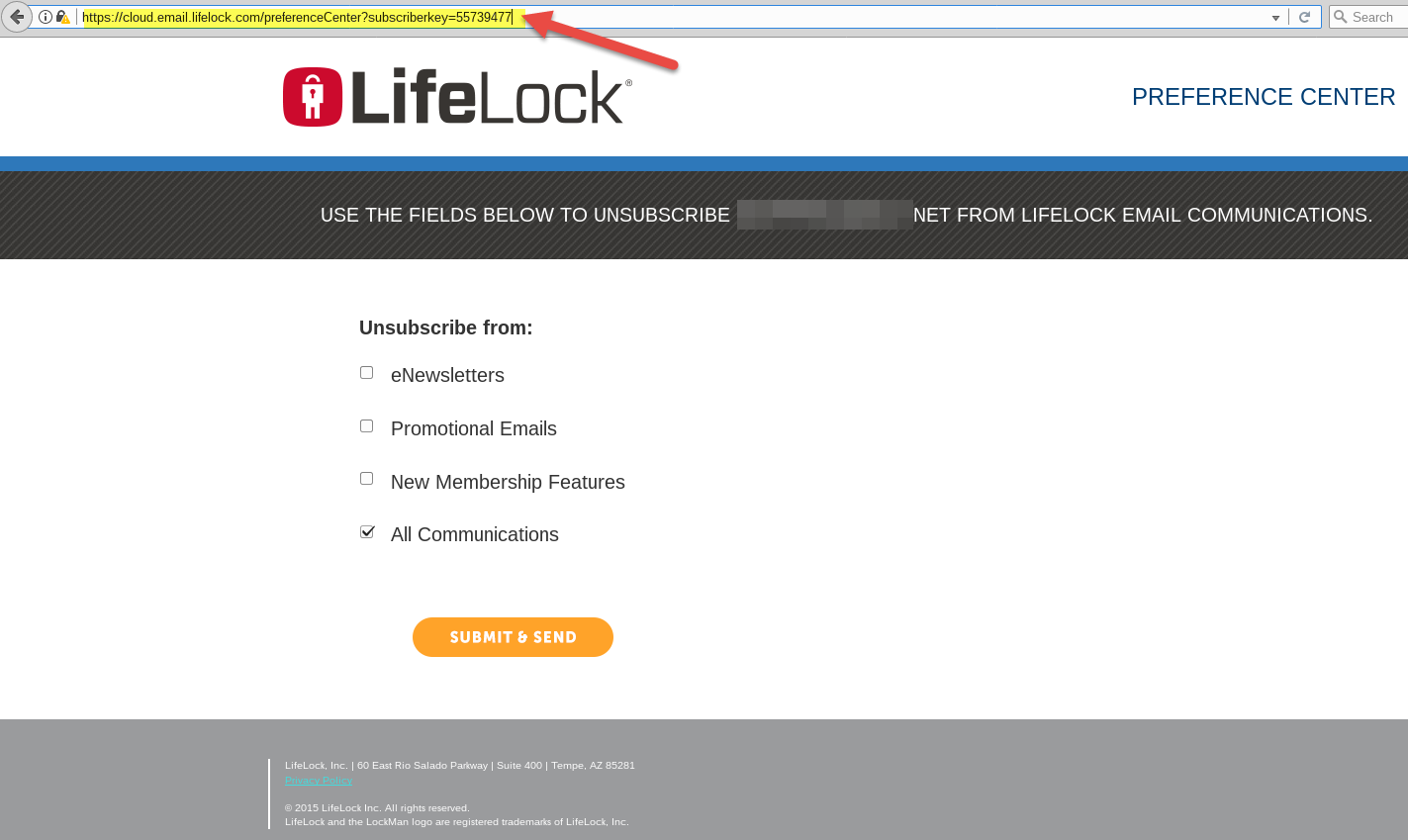
LifeLock’s Web site exposed customer email addresses by tying each customer account to a numeric “subscriberkey” that could be easily enumerated. Pictured above is customer number 55,739,477. Click to enlarge.

Pictured above is a redacted screen shot of one such record (click the image to enlarge). Notice how the format of the link in the browser address bar ends with the text “subscriberkey=” followed by a number. Each number corresponds to a customer record, and the records appear to be sequential. Translation: It would be trivial to write a simple script that pulls down the email address of every LifeLock subscriber.

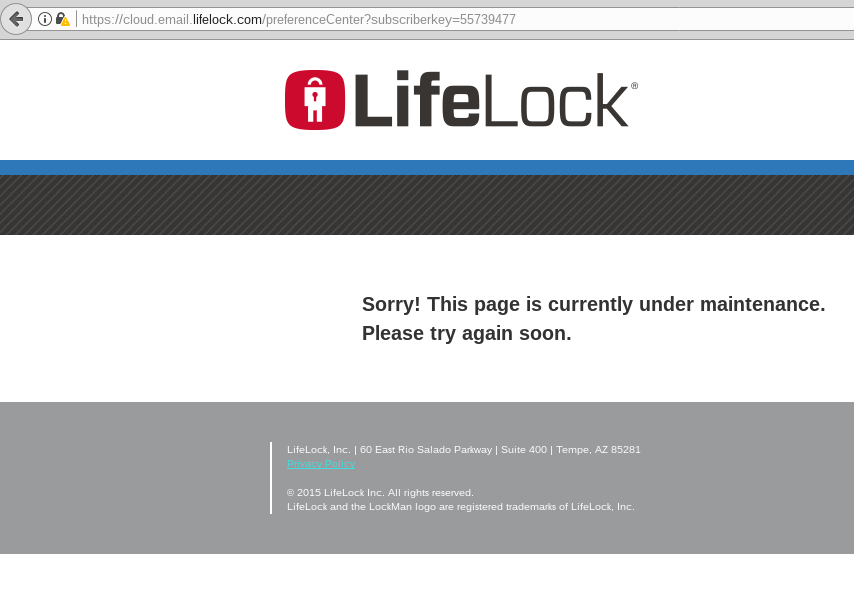
Security firm Symantec, which acquired LifeLock in November 2016 for $2.3 billion, took LifeLock.com offline shortly after being contacted by KrebsOnSecurity. According to LifeLock’s marketing literature, the company has more than 55 million customer accounts.

KrebsOnSecurity was alerted to the glaring flaw by Nathan Reese, a 42-year-old freelance security researcher based in Atlanta who is also a former LifeLock subscriber. Reese said he discovered the data leak after receiving an email to the address he had previously used at LifeLock, and that the message offered him a discount for renewing his membership.

Clicking the “unsubscribe” link at the bottom of the email brought up a page showing his subscriber key, which was in the 55 million ballpark (55739477, to be exact). From there, Reese said, he wrote a proof-of-concept script that began sequencing numbers and pulling down email addresses. Reese said he stopped the script after it enumerated approximately 70 emails because he didn’t want to set off alarm bells at LifeLock.

“If I were a bad guy, I would definitely target your customers with a phishing attack because I know two things about them,” Reese said. “That they’re a LifeLock customer and that I have those customers’ email addresses. That’s a pretty sharp spear for my spear phishing right there. Plus, I definitely think the target market of LifeLock is someone who is easily spooked by the specter of cybercrime.”

LifeLock’s Web site is currently offline.

Misconfigurations like the one described above are some of the most common ways that companies leak customer data, but they’re also among the most preventable. Earlier this year, KrebsOnSecurity broke a story about a similar flaw at Panerabread.com, which exposed tens of millions of customer records — including names, email and physical addresses, birthdays and the last four digits of the customer’s credit card.


from
https://krebsonsecurity.com/2018/07/lifelock-bug-exposed-millions-of-customer-email-addresses/

Tuesday, July 24, 2018

Hackers Breached Virginia Bank Twice in Eight Months, Stole $2.4M

Hackers used phishing emails to break into a Virginia bank in two separate cyber intrusions over an eight-month period, making off with more than $2.4 million total. Now the financial institution is suing its insurance provider for refusing to fully cover the losses.

According to a lawsuit filed last month in the Western District of Virginia, the first heist took place in late May 2016, after an employee at The National Bank of Blacksburg fell victim to a targeted phishing email.

The email allowed the intruders to install malware on the victim’s PC and to compromise a second computer at the bank that had access to the STAR Network, a system run by financial industry giant First Data that the bank uses to handle debit card transactions for customers. That second computer had the ability to manage National Bank customer accounts and their use of ATMs and bank cards.

Armed with this access, the bank says, hackers were able to disable and alter anti-theft and anti-fraud protections, such as 4-digit personal identification numbers (PINs), daily withdrawal limits, daily debit card usage limits, and fraud score protections.

National Bank said the first breach began Saturday, May 28, 2016 and continued through the following Monday. Normally, the bank would be open on a Monday, but that particular Monday was Memorial Day, a federal holiday in the United States. The hackers used hundreds of ATMs across North America to dispense funds from customer accounts. All told, the perpetrators stole more than $569,000 in that incident.

Following the 2016 breach, National Bank hired cybersecurity forensics firm Foregenix to investigate. The company determined the hacking tools and activity appeared to come from Russian-based Internet addresses.

In June of 2016, National Bank implemented additional security protocols, as recommended by FirstData. These protocols are known as “velocity rules” and were put in place to help the bank flag specific types of repeated transaction patterns that happen within a short period of time

But just eight months later — in January 2017 according to the lawsuit — hackers broke in to the bank’s systems once more, again gaining access to the financial institution’s systems via a phishing email.

This time not only did the intruders regain access to the bank’s STAR Network, they also managed to compromise a workstation that had access to Navigator, which is software used by National Bank to manage credits and debits to customer accounts.

Prior to executing the second heist, the hackers used the bank’s Navigator system to fraudulently credit more than $2 million to various National Bank accounts. As with the first incident, the intruders executed their heist on a weekend. Between Jan. 7 and 9, 2017, the hackers modified or removed critical security controls and withdrew the fraudulent credits using hundreds of ATMs.

All the while, the intruders used the bank’s systems to actively monitor customer accounts from which the funds were being withdrawn. At the conclusion of the 2017 heist, the hackers used their access to delete evidence of fraudulent debits from customer accounts. The bank’s total reported loss from that breach was $1,833,984.

Verizon was hired to investigate the 2017 attack, and according to the bank Verizon’s forensics experts concluded that the tools and servers used by the hackers were of Russian origin. The lawsuit notes the company determined that it was likely the same group of attackers responsible for both intrusions. Verizon also told the bank that the malware the attackers used to gain their initial foothold at the bank in the 2017 breach was embedded in a booby-trapped Microsoft Word document.

THE LAWSUIT

In its lawsuit (PDF), National Bank says it had an insurance policy with Everest National Insurance Company for two types of coverage or “riders” to protect it against cybercrime losses. The first was a “computer and electronic crime” (C&E) rider that had a single loss limit liability of $8 million, with a $125,000 deductible.

The second was a “debit card rider” which provided coverage for losses which result directly from the use of lost, stolen or altered debit cards or counterfeit cards. That policy has a single loss limit of liability of $50,000, with a $25,000 deductible and an aggregate limit of $250,000.

According to the lawsuit, in June 2018 Everest determined both the 2016 and 2017 breaches were covered exclusively by the debit card rider, and not the $8 million C&E rider. The insurance company said the bank could not recover lost funds under the C&E rider because of two “exclusions” in that rider which spell out circumstances under which the insurer will not provide reimbursement.

The first of those exclusions rules out coverage for any loss “resulting directly or indirectly from the use or purported use of credit, debit, charge, access, convenience, or other cards . . . (1) in obtaining credit or funds, or (2) in gaining access to automated mechanical devices which, on behalf of the Insured, disburse Money, accept deposits, cash checks, drafts or similar Written instruments or make credit card loans . . ..”

The second exclusion in the C&E rider negates coverage for “loss involving automated mechanical devices which, on behalf of the Insured, disburse Money, accept deposits, cash checks, drafts or similar Written instruments or make credit card loans . . ..”

“In its Coverage Determination, Everest further determined that the 2016 Intrusion and the 2017 Intrusion were a single event, and thus, pursuant to the Debit Card Rider, National Bank’s total coverage under the Bond was $50,000.00 for both intrusions,” the bank said in its lawsuit.

Everest National Insurance Company did not respond to requests for comment. But on July 20 it filed a response (PDF) to the bank’s claims, alleging that National Bank has not accurately characterized the terms of its coverage or fully explained the basis for Everest’s coverage decision.

Charisse Castagnoli, an adjunct professor with The John Marshall Law School, said the bank’s claim appears to be based on a legal concept known as “proximate cause,” a claim that usually includes the telltale term “but for,” as this lawsuit does throughout.

“Proximate cause tries to get at where’s the legal liability associated with the original element that caused the loss,” Castagnoli said. “Take the example of a car crash victim whose master cylinder in the vehicle ran out of fluid and as a result the driver ran a red light and hit another car. The driver at fault might make the claim in a lawsuit against the car maker ‘but for your failure to manufacture this part correctly, this accident wouldn’t have occurred.'”

In this case, Castagnoli said what the bank seems to be claiming is that the Debit Card Rider shouldn’t apply because — but for the computer hacking — the losses wouldn’t have occurred. Indeed, the bank’s lawsuit claims: “All losses related to the 2017 Intrusion were the result of and would not have been possible but for the hacking of National Bank’s Computer Systems which resulted in the entering or changing of Electronic Data and Computer Programs within the Computer Systems.”

“Therefore, even though the losses were physically sustained  through ATM extractions, the Debit Card Rider limits shouldn’t apply because that kind of a rider doesn’t contemplate the dynamic changes in credit limits, and overrides of fraud monitoring, were only possible through computer hacking to which the C&E Rider should apply,” Castagnoli explained.

The bank’s complaint against Everest notes that the financial institution doesn’t yet know for sure how the thieves involved in the 2017 breach extracted funds. In previous such schemes (known as “unlimited cashouts“), the fraudsters orchestrating the intrusion recruit armies of “money mules” — usually street criminals who are given cloned debit cards and stolen or fabricated PINs along with instructions on where and when to withdraw funds.

Castagnoli said establishing and proving these fine lines of proximate cause can be very difficult in insurance claims.

“While it is fairly easy to write a policy around data breach liability, when it comes to actual intrusions and managing intrusions, it’s a wild wild west,” she said. “The policies and definitions they use are not consistent across carriers.”

Castagnoli advises companies contemplating cyber insurance policies to closely scrutinize their policies and riders, and find an expert who can help craft a policy that is tailored for the insured.

“The serious brokers who are out there selling cyber insurance all say the same thing: Have an expert help you to write your policy,” she said. “It’s mind-numbingly complicated and we don’t have standard language in insurance policies that help insurance clients decide what policy is right for them.”

She added that although there have been a handful of cases where cyber insurance providers have denied coverage to the insured, most of those disputes have been settled out of court.

“This is a rapidly growing area and a profit center for a lot of insurance companies,” Castagnoli said. “But there is not a lot of published case law on this, and you have to wonder if something public comes out like this what it’s going to do to the reputation of the industry.”


from
https://krebsonsecurity.com/2018/07/hackers-breached-virginia-bank-twice-in-eight-months-stole-2-4m/

Monday, July 23, 2018

Google: Security Keys Neutralized Employee Phishing

Google has not had any of its 85,000+ employees successfully phished on their work-related accounts since early 2017, when it began requiring all employees to use physical Security Keys in place of passwords and one-time codes, the company told KrebsOnSecurity.

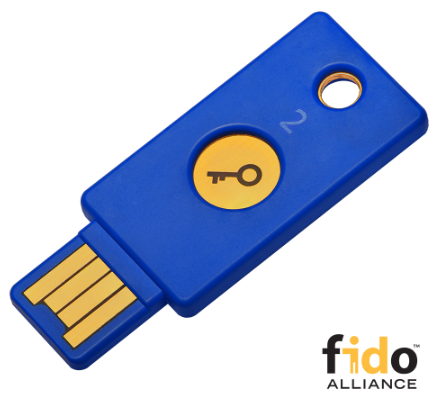
A YubiKey Security Key made by Yubico. The basic model featured here retails for $20.

Security Keys are inexpensive USB-based devices that offer an alternative approach to two-factor authentication (2FA), which requires the user to log in to a Web site using something they know (the password) and something they have (e.g., a mobile device).

A Google spokesperson said Security Keys now form the basis of all account access at Google.

“We have had no reported or confirmed account takeovers since implementing security keys at Google,” the spokesperson said. “Users might be asked to authenticate using their security key for many different apps/reasons. It all depends on the sensitivity of the app and the risk of the user at that point in time.”

The basic idea behind two-factor authentication is that even if thieves manage to phish or steal your password, they still cannot log in to your account unless they also hack or possess that second factor.

The most common forms of 2FA require the user to supplement a password with a one-time code sent to their mobile device via text message or an app. Indeed, prior to 2017 Google employees also relied on one-time codes generated by a mobile app — Google Authenticator.

In contrast, a Security Key implements a form of multi-factor authentication known as Universal 2nd Factor (U2F), which allows the user to complete the login process simply by inserting the USB device and pressing a button on the device. The key works without the need for any special software drivers.

Once a device is enrolled for a specific Web site that supports Security Keys, the user no longer needs to enter their password at that site (unless they try to access the same account from a different device, in which case it will ask the user to insert their key).

U2F is an emerging open source authentication standard, and as such only a handful of high-profile sites currently support it, including Dropbox, Facebook, Github (and of course Google’s various services). Most major password managers also now support U2F, including Dashlane, Keepass and LastPass. Duo Security [full disclosure: an advertiser on this site] also can be set up to work with U2F.

With any luck, more sites soon will begin incorporating the Web Authentication API — also known as “WebAuthn” — a standard put forth by the World Wide Web Consortium in collaboration with the FIDO Alliance. The beauty of WebAuthn is that it eliminates the need for users to constantly type in their passwords, which negates the threat from common password-stealing methods like phishing and man-in-the-middle attacks.

Currently, U2F is supported by Chrome, Mozilla Firefox, and Opera. In both Firefox and Quantum (the newer, faster version of Firefox), U2F is not enabled by default. To turn it on, type “about:config” in the browser bar, type or paste “security.webauth.u2f” and double-click the resulting entry to change the preference’s value from “false” to “true.”

Microsoft says it expects to roll out updates to its flagship Edge browser to support U2F later this year. According to a recent article at 9to5Mac.com, Apple has not yet said when or if it will support the standard in its Safari browser.

Probably the most popular maker of Security Keys is Yubico, which sells a basic U2F key for $20 (it offers regular USB versions as well as those made for devices that require USB-C connections, such as Apple’s newer Mac OS systems). Yubikey also sells more expensive U2F keys designed to work with mobile devices.

If a site you frequent does not yet support WebAuthn, please consider hardening your login with another form of 2FA. Hundreds of sites now support multi-factor authentication. Twofactorauth.org maintains probably the most comprehensive list of which sites support 2FA, indexing each by type of site (email, gaming, finance, etc) and the type of 2FA offered (SMS, phone call, software token, etc.).

In general, using SMS and automated phone calls to receive a one-time token is less secure than relying on a software token app like Google Authenticator or Authy. That’s because thieves can intercept that one-time code by tricking your mobile provider into either swapping your mobile device’s SIM card or “porting” your mobile number to a different device. However, if the only 2FA options offered by a site you frequent are SMS and/or phone calls, it is still better than simply relying on a password.

While we’re on the subject of multi-factor authentication, I should note that Google now offers an extra set of security measures for all of its properties called Advanced Protection. Exactly how Google’s Advanced Protection works (and the trade-offs involved in turning it on) will likely be the subject of another story here, but Wired.com recently published a decent rundown about it. Incidentally, this article includes a step-by-step guide on how to incorporate Security Keys into Advanced Protection.

I have been using Advanced Protection for several months now without any major issues, although it did take me a few tries to get it set up correctly. One frustrating aspect of having it turned on is that it does not allow one to use third-party email applications like Mozilla’s Thunderbird or Outlook. I found this frustrating because as far as I can tell there is no integrated solution in Gmail for PGP/OpenGPG email message encryption, and some readers prefer to share news tips this way. Previously, I had used Thunderbird along with a plugin called Enigmail to do that.


from
https://krebsonsecurity.com/2018/07/google-security-keys-neutralized-employee-phishing/

Thursday, July 19, 2018

Human Resources Firm ComplyRight Breached

Cloud-based human resources company ComplyRight said this week that a security breach of its Web site may have jeopardized sensitive consumer information — including names, addresses, phone numbers, email addresses and Social Security numbers — from tax forms submitted by the company’s thousands of clients on behalf of employees.

Pompano Beach, Fla-based ComplyRight began mailing breach notification letters to affected consumers late last week, but the form letters are extremely vague about the scope and cause of the breach. Indeed, many readers who received these letters wrote to KrebsOnSecurity asking for more information, as the company hadn’t yet published any details about the breach on its Web site. Also, most of those folks said they’d never heard of ComplyRight and could not remember ever doing business with a company by that name.

Neither ComplyRight nor its parent company Taylor Corp. responded to multiple requests for comment this past week. But on Wednesday evening, ComplyRight posted additional facts about the incident on its site, saying a recently completed investigation suggests that fewer than 10 percent of individuals with tax forms prepared on the ComplyRight platform were impacted.

According to ComplyRight’s Web site, some 76,000 organizations — many of them small businesses — use its services to prepare tax forms such as 1099s and W2s on behalf of their employees and/or contractors. While the company didn’t explicitly say which of its cloud services was impacted by the breach, the Web site which handles its tax preparation business is efile4biz.com.

ComplyRight says it learned of the breach on May 22, 2018, and that the “unauthorized access” to its site persisted between April 20, 2018 and May 22, 2018.

ANALYSIS

Even with the additional disclosure published to ComplyRight’s site, it’s difficult to accurately gauge the size of this breach. ComplyRight includes information about its tax solutions division here and it appears that they also file Affordable Care Act (ACA) and HIPAA paperwork. So, if these “solutions” are indeed part of the “tax reporting web platform,” then we’re probably talking way more beyond efile4biz.com’s 76,000 customers. And remember that each “customer” is a business that employs multiple people.

ComplyRight’s efile4biz.com Web site has long stated that the company employs the latest, most sophisticated security measures, noting that “the result is a level of data protection that would thwart even the most determined cyber criminals.”

“Data security is a primary concern with reputable e-file providers like efile4Biz.com,” the site explains. “We use the strongest encryption program available, as recommended by the federal government, to block the interception or interruption of information by a third party. “Data is encrypted as soon as it’s entered on the site, and it says encrypted throughout the entire print, mail and e-file process.”

The site also includes a Geotrust security seal intended to reinforce the above statement. While ComplyRight hasn’t said exactly how this breached happened, the most likely explanation is that intruders managed to install malicious code on the efile4biz.com Web site — malware that recorded passwords entered into the site by employers using the service to prepare tax forms.

Translation: Assurances about the security of data in-transit to or from the company’s site do little to stop cyber thieves who have compromised the Web site itself, because there are countless tools bad guys can install on a hacked site that steals usernames, passwords and other sensitive data before the information is even encrypted and transmitted across the wire.

Also, it’s far from clear that data security is in fact a primary concern of ComplyRight. Let me explain: Very often when I’m having difficulty getting answers or responses from a company that I suspect or know has had a breach, I’ll start identifying and pestering the company’s executives via their profiles on LinkedIn.

As I did so in this case, I was surprised to discover that I couldn’t identify a single ComplyRight employee on Linkedin whose job is listed as at all related to security. Nor does it appear that ComplyRight is currently hiring anyone in these positions. I did, however, find plenty of network managers and software engineers, Web developers and designers, data specialists, and even several “poster guard specialists” (ComplyRight also produces workplace safety posters of the kind typically hung in corporate breakrooms).

It may well be that there are indeed security personnel working at ComplyRight, but if so they don’t seem to have a LinkedIn profile. Again, neither ComplyRight nor its parent firm responded to multiple requests for comment.

WHAT CAN YOU DO?

The company is offering 12 months of free credit monitoring to those affected by the breach. As I’ve noted several times here, credit monitoring can be useful for helping people recover from identity theft, it is virtually useless in stopping identity thieves from opening new accounts in your name.

A more comprehensive approach to combating ID theft involves adopting the assumption that all of this static data about you as a consumer — including your name, date of birth, address, previous address, phone number, credit card number, Social Security number and possibly a great deal more sensitive information — is already breached, stolen and/or actively for sale in the cybercrime underground.

One response to this increasingly obvious reality involves enacting a security freeze on one’s credit files with the major consumer credit reporting bureaus. See this primer from last year’s breach at Equifax for more details on how to do that, and for information on slightly less restrictive alternatives.

In addition, people who received a letter from ComplyRight may also file a Form 14039 with the U.S. Internal Revenue Service (IRS) to help reduce the likelihood of becoming victims of tax refund fraud, an increasingly common scam in which fraudsters file a tax refund request with the IRS in your name and then pocket the refund money.

Any American can be a victim of refund fraud, whether or not they are owed money by the IRS. Most people first learn they are victims when they go to file their tax return and the submission is rejected because someone already filed in their name.

By filing a Form 14039, you are asking the IRS to issue you a special one-time code — called an IP PIN — via snail mail that must be entered on subsequent tax returns before the return can be accepted by the IRS.

A couple of caveats about this form: If you request and are granted an IP PIN, make sure you store the information in a safe place that you will be able to access next year when it comes time to file your taxes again (a clearly labeled folder in a locked filing cabinet is a good start).

Also, understand that enrolling in the IP PIN program requires taxpayers to pass an identity-proofing process called Secure Access. This process includes making specific credit inquiries to big-three credit bureau Experian, which means if you already have a security freeze on your consumer credit file with Experian you will need to temporarily thaw the freeze before completing the enrollment. For those contemplating a freeze and seeking an IP PIN, complete the Secure Access enrollment with the IRS before enacting a freeze.


from
https://krebsonsecurity.com/2018/07/human-resources-firm-complyright-breached/

Monday, July 16, 2018

‘LuminosityLink RAT’ Author Pleads Guilty

A 21-year-old Kentucky man has pleaded guilty to authoring and distributing a popular hacking tool called “LuminosityLink,” a malware strain that security experts say was used by thousands of customers to gain unauthorized access to tens of thousands of computers across 78 countries worldwide.

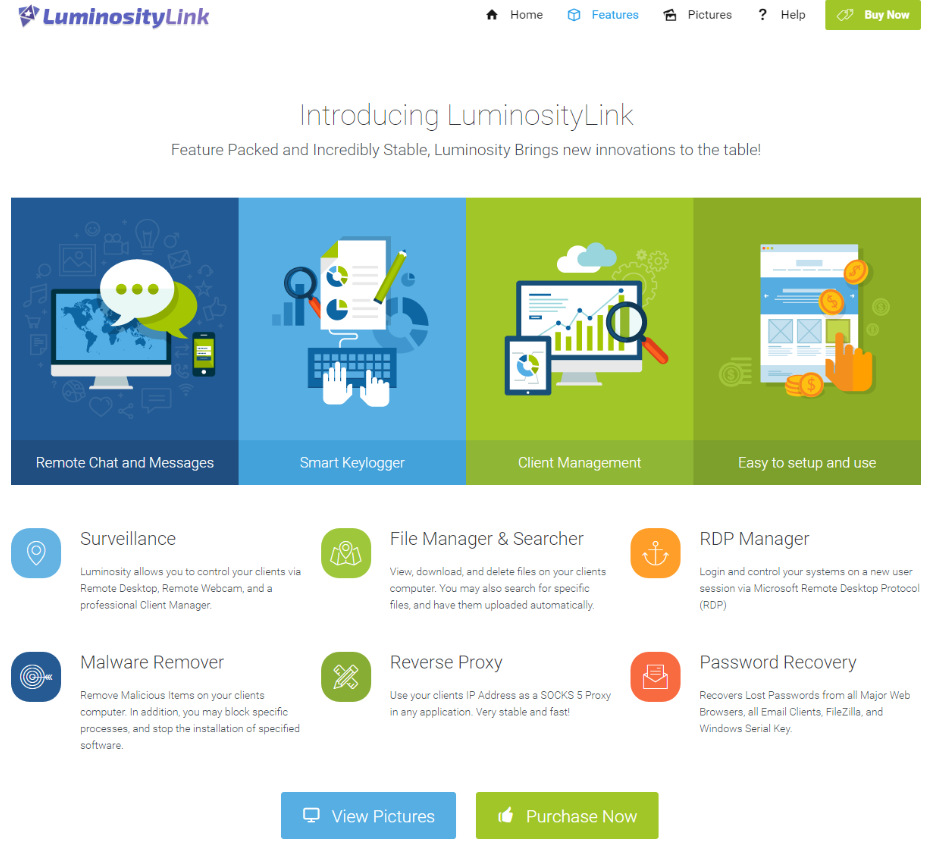
The LuminosityLink Remote Access Tool (RAT) was sold for $40 to thousands of customers, who used the tool to gain unauthorized access to tens of thousands of computers worldwide.

Federal prosecutors say Colton Ray Grubbs of Stanford, Ky. conspired with others to market and distribute the LuminosityLink RAT, a $40 Remote Access Tool that made it simple for buyers to hack into computers to surreptitiously view documents, photographs and other files on victim PCs. The RAT also let users view what victims were typing on their keyboards, disable security software, and secretly activate the webcam on the target’s computer.

Grubbs, who went by the pseudonym “KFC Watermelon,” began selling the tool in May 2015. By mid-2017 he’d sold LuminosityLink to more than 8,600 customers, according to Europol, the European Union’s law enforcement agency.

Speculation that Grubbs had been arrested began surfacing last year after KFC Watermelon stopped responding to customer support queries on Hackforums[dot]net, the Web site where he primarily sold his product.

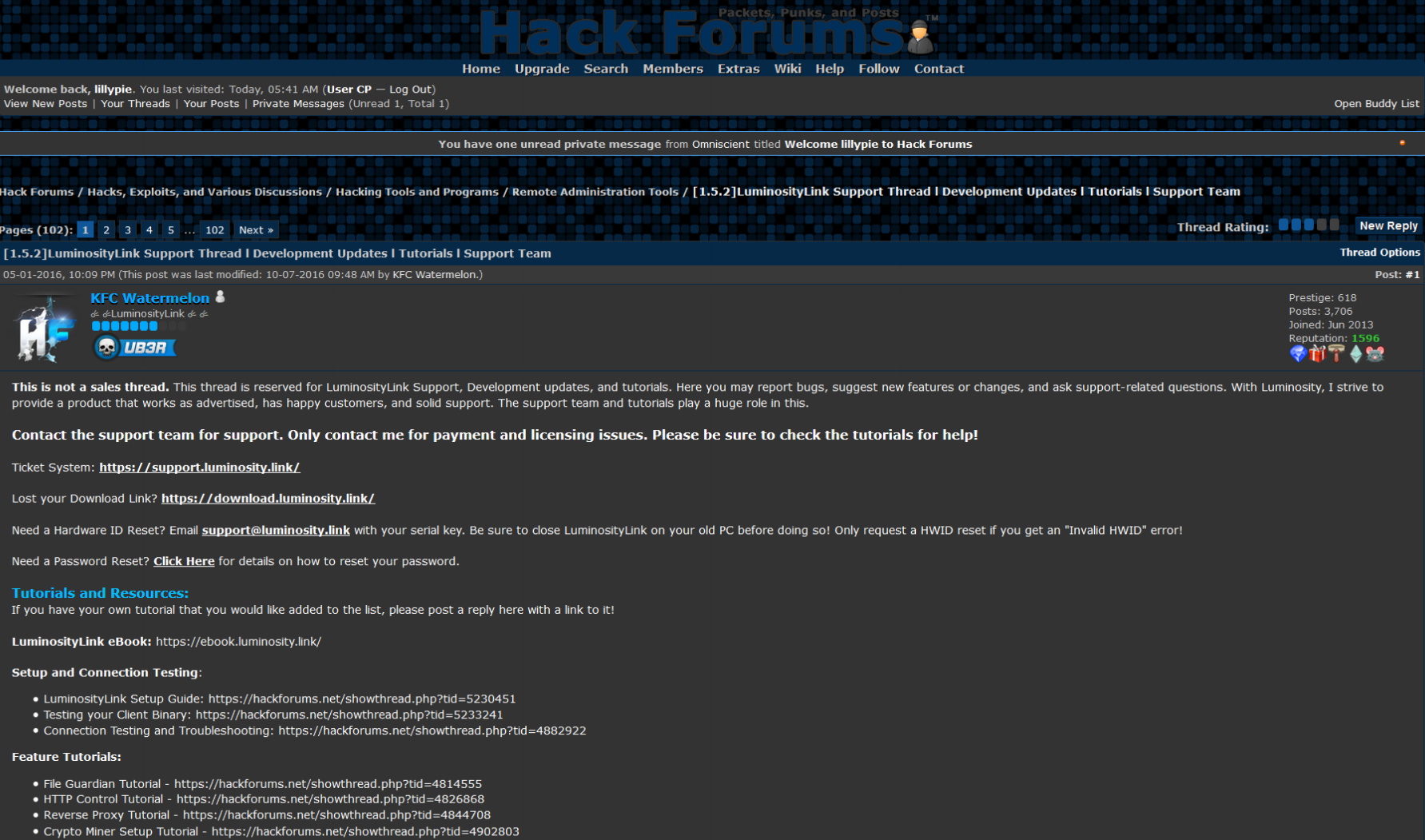
Grubbs, using the hacker nickname “KFC Watermelon,” advertised and sold his RAT via Hackforums.net.

The sale and marketing of remote access tools, also known as remote administration tools, is not illegal in the United States, and indeed there are plenty of such tools sold by legitimate companies to help computer experts remotely administer computers.

However, these tools tend to be viewed by prosecutors instead as “Remote Access Trojans” when their proprietors advertise the programs as hacking devices and provide customer support aimed at helping buyers deploy the RATs stealthily and evade detection by anti-malware programs.

According to the indictment against him, Grubbs “recruited and encouraged co-conspirators to answer questions on Skype, an internet messaging service, from potential and actual purchasers of LuminosityLink seeking to use the software to get unauthorized and undetected access to victim computers and steal information.”

Linking Grubbs to LuminosityLink was likely not a tall hurdle for prosecutors. A public filing at the Kentucky Secretary of State office lists Grubbs as the owner of Luminosity Security Solutions LLC.

However, there are indications that Luminosity was not Grubb’s first foray into making and selling malware tools. According to a February 2018 blog post by Palo Alto Networks, the Skype account connected to KFC Watermelon’s identity on Hackforums is tied to the email address “codyjohnson1337@live.com; that email account was used in 2013 to register “plasmarat.pw,” a similar RAT sold and marketed on Hackforums.

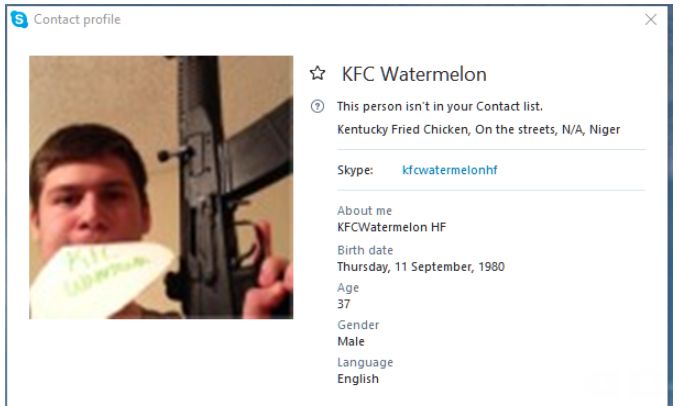
KFC Watermelon’s Skype profile (the “HF” in his Skype name is a likely reference to HackForums, where both Luminosity RAT and Plasma RAT were primarily sold and marketed).

The street address listed by the Kentucky Secretary of State’s office for Luminosity Security Solutions (127 Circle Dr., Stanford, KY) shows up in the original registration records for dozens of domains, including at least a half-dozen that early on listed the email address coltongrubbs@gmail.com. That same email address appears in the early registration records for barracudasec[dot]com, a domain that as far back as 2012 was identified as a popular “command and control” server that many denizens of Hackforums used to remotely administer large numbers of remotely commandeered computers or “bots.”

Around the time that KFC Watermelon stopped responding to support requests on Hackforums, federal prosecutors were securing a guilty plea against Taylor Huddleston, a then 27-year-old programmer from Arkansas who sold the “NanoCore RAT.”  Like Grubbs, Huddleston initially pleaded not guilty to computer intrusion charges, arguing that he wasn’t responsible for how customers used his products. That is, until prosecutors presented Skype logs showing that Huddleston routinely helped buyers work out how to use the tools to secretly compromise remote computers.

Grubbs’ guilty plea could well lead to further arrests and prosecutions of customers who purchased and used LuminosityLink. Case in point: The author of the Blackshades Trojan — once a wildly popular RAT sold principally on Hackforums — was arrested along along with dozens of his customers in a global law enforcement sweep in 2014.

Indeed, many former customers of LuminosityLink have posted to Hackforums that they are expecting similar treatment:

Hackforums users speculate that Grubbs’ arrest could lead to the arrest and prosecution of his customers. Image: Palo Alto Networks.

Grubbs initially pleaded not guilty, and his trial was slated to begin in August. But in a plea agreement released today, Grubbs admitted to conspiring to make and sell LuminosityLink, and to knowingly assisting customers in using his software to break into computers.

The plea agreement notes that on July 10, 2017, when Grubbs found out the the FBI was about to raid his apartment, he hid the phone and debit card tied to his Bitcoin account, and also removed the hard drives from his computer and apartment prior to the search. “Three days later, Defendant transferred over 114 bitcoin from his LuminosityLink bitcoin address into six new bitcoin addresses,” the agreement states.

The charges to which Grubbs has pleaded guilty carry punishments of up to 25 years in prison and as much as $750,000 in fines, although any sentence the judge hands down in this case may be significantly tempered by U.S. Sentencing Guidelines.

A copy of the plea agreement is available here (PDF).


from
https://krebsonsecurity.com/2018/07/luminositylink-rat-author-pleads-guilty/